
18 September 2026
On Wednesday 16 September, our Year 13 Gold Duke of Edinburgh’s Award (D of E) participants gathered in the Theatre for an inspiring evening of celebration, storytelling, and reflection. Delivering their expedition presentations as required by the highest level of the Award scheme, the student teams showcased not only their physical journeys across challenging landscapes in the UK and Europe, but also the remarkable resilience, camaraderie, and problem-solving skills forged throughout the Gold programme.
Addressing an audience of proud parents, carers, peers, and school staff, each of the seven expedition groups delivered a polished presentation. They reflected on their specific expedition aims, recounted unforgettable highlights, and shared how they navigated demanding physical and mental hurdles along the way. The maturity, humour, and public speaking skills displayed on stage enabled the audience to learn about the angle of gables roofs of alpine chalets, the waterfowl and varied land use around the River Wye, the altitude-dependence of fauna in Eryri National Park, and how expedition life affected mood in extreme heat.
During the interval, guests enjoyed a wonderful selection of refreshments provided by our wonderful Refuel catering team, providing an opportunity for families to mingle and toast the students' efforts.
Congratulations to all our Gold D of E participants for completing this milestone section of their Award with such flair. The entire school community is proud of your leadership, perseverance, and outstanding achievements! The Gold D of E Award involves several commitments of 6-18 months as well as the residential and expedition sections. All participants who complete their Award in full are given the opportunity to attend a Royal Palace in recognition of their achievements.
Mr Guy-Fierens
Duke of Edinburgh Award Manager


Fundraising News
Recently, we received a message of thanks from 'It's in the Bag' one of the charities nominated by Turing House, to receive a share of the money raised through non uniform days and the Summer Festival, during the last academic year.
'It's in the Bag' advised that the donation "will make a significant difference to us and what we can do to help guys and their families". They also said that the money they received paid for two travel grants to get lads from Devon and Cornwall to Bristol for life saving treatment and finished by saying that "DHSB has directly saved two lives which is phenomenal!".
The donation highlights the direct, tangible impact fundraising can have and through the generosity of the DHSB community, we have provided a vital lifeline for two local families during their most challenging moments. Thank you.
You can find out more about the charity and make a donation if you wish, by following this link.
Year 7 Student Wins University of Plymouth Computer Science Poster Competition
Congratulations to Year 8 student Pranav, who was recognised in the University of Plymouth's inaugural Computer Science Poster Competition.
The competition invited students in Years 7-9 to combine creativity with critical thinking by designing an eye-catching and informative poster exploring "The Impact of Artificial Intelligence in Everyday Life." Entrants were challenged to demonstrate how AI is already influencing our daily lives, where it can be found in areas such as home, school, transport and entertainment, and how it might shape the future. Posters were judged on their understanding of the topic, creativity, originality, visual impact and clarity of communication.
The standard of entries was exceptionally high, making this a fantastic achievement. Pranav was awarded a certificate, a computer science book, and a large professionally printed copy of the winning poster, providing a lasting reminder of this impressive accomplishment.
The competition encouraged students to think beyond simply using technology, instead considering its wider impact on society while developing their creativity, computing knowledge and communication skills. It also provided an excellent opportunity for students to engage with a real-world topic that is becoming increasingly important across education, industry and everyday life.
Well done to Pranav on this well-deserved recognition. We are incredibly proud of this achievement and look forward to seeing more of our students take part in future competitions that celebrate innovation, creativity and computer science.
Special mention to Alfie (Y8), Dylan (Y11), Cuba (Y8), Roland (Y8) and Jude (Y8) whose entries were also commended.
Mr Scott
Head of Computer Science


Recognising Excellence Winner...
Mr Spencer, Teacher of Science, KS3 Science Coordinator and our STEM (Science, Technology, Engineering, Mathematics) Coordinator, has recently been named as a winner by the Recognising Excellence Programme in South West England.
The award was given for working hard to "inspire and engage young people to discover a passion for STEM" and in recognition of the time and effort that Mr Spencer puts into his activities and enabling students to access STEM opportunities.
Congratulations!

Imperial College Science in Medicine School Teams Prize 2026 - Lung Prize Finalists!
DHSB are proud to share that a team of six Year 13 DHSB students have been shortlisted for a Science in Medicine prize. 87 entires were submitted nationally for the Lung Prize and after careful review by a panel of 29 judges, the DHSB team have made it to the Top 10!
Joe, Dennis, Jack, Toby, Tobias, Agsheyan and Khushaal now have to give an online presentation about their e-poster to a panel of experts and others at the beginning of November.
The prize is co-funded by the National Heart and Lung Institute and the Respiratory Theme of the Imperial NIHR Biomedical Research Centre and is offered to engage sixth form school students with science in medicine.
To find out more about 'The Lung Prize' and the aims of the Science in Medicine School Teams Prize, please follow this link.
Well done and good luck!

Excellent Work from English Literature
Year 12 students have started the A Level Literature course with an exploration of English canon. This is the collection of texts - plays, poems and novels - which are critically regarded as representing the finest and most important pieces of literature. As part of this they have looked at the role of Anglo Saxon literature in the development of poetry. experimenting with using typical features in their own poetry. Those rose to the challenge brilliantly and these are some of their poems using kennings which are unusual but apt compound words used in the place of simple nouns.
Memory’s ache by Maisie
My mid-museum haunted by the ghostly warmth of days of old
A cacophony of youth’s echos launching into a set
The weighted wishfulness of yesterday tethering me in time, taking me
back to our chalk-kingdom or the vibrant days of scratched-knee-season
Fresh memories bake in our kitchen of dirt
and mindless giants overshadowed our golden haze
Childhood’s anchor securing me in a sea of senior sincerity,
waves washing over me like the passing of time and tenderness
Fire- Breather by Vinnie
Dashing, Darting, Destructive, the fire-breather flew
Scales glimmering, gliding, from a place where no-one knew
Time-Wasters snapping, flashing, stood without a clue
As their death-reaper awaits for a new soul or two
The majestic beast had escaped from its chamber
Imprisoned for centuries, growing in anger
For the oxygen-breathers who had locked him away
He was intent on making sure they didn’t live for another day
Smoke rose as the red-heat filled their eyes,
The village erupted into spine-shivering cries
The sky-glider had won the battle,
Turning ancient lies into ashes
Ivory Kings By Jamie
As the day-bringer rode its way across the dawn,
The pig-feeder awoke to the sound of the wailing-crown,
A letter brandished the seal of the Elephant-tusk,
‘You will fight in a land unknown, against an enemy unknown, for a king
you do not know’.
The clash of bone-rippers rung out across the blood-field,
Against Kings-men he stands alone, hay-piercer in hand,
His soul shall not be taken so easily, chest-embers burning fervorously,
As his blood-pumper is unseamed, the mind plays fond memories of his
kin-spawn.
The crop-defilers prowl this resting place,
Blood's seats littered the land, a reminder of the meaningless lives lost.
How can we call this victory, wives are left widowed, children are orphaned.
All of this death to satisfy the ego of a disassociate king, sat on his ivory-throne.
The Sleeping World by Sophie
Above the sleeping world the night-lantern rose
Whispering hushed melodies where the earth-breather blows
Across eerie waters the tide-puller calls
And over the shore-breaker the moonlight falls
Through delicate mist-bands the dream-watcher gleams
Listening to the secrets of the tide-travellers dreams
Kept company by the sky-jewels all night
The night-beacon lowers without a fight
Summer Nostalgia by Martha
Ocean's-whisper churns
Heaven's blanket engulfs the swallowed sky
The shore-cleanser renews the soaked shingle
Moment-snatcher postpones goodbye.
Perfume of the embers
Conceals beacon-blush
A signature of the sun as we absorb the coastal crust
The gold is only memory as June days begin to rust..
Dr Downes
Head of English

Excellent Work from Classic Civilisations
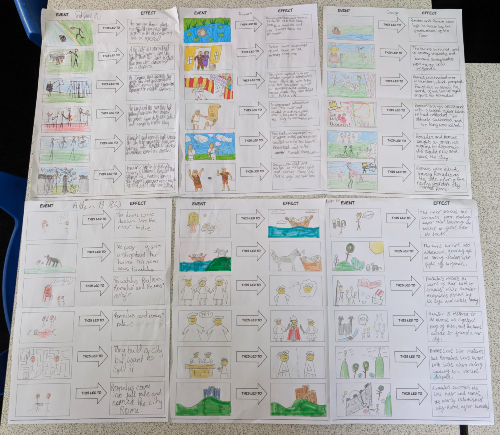
This week students from 8W have been looking at the myth that surrounds the Founding of Rome. Students have been looking at how the She-Wolf found, looked after and supported the twins of Romulus and Remus. The students have been hard at work, thinking about how each event has an effect in the myth and how we (and those from Rome) view the myth today.
Below are some of their excellent story boards. Visualising the story is a fantastic way of getting students to remember the myth and enables those in 8W to consider what parts of the myth could be factually accurate, while others are fiction.
Well done to those in 8W this week.
Mr Liddington
Teacher of Humanities
Sparx Maths and Sparx Reader
Each week we celebrate our highest performers in both Sparx Maths and Sparx Reader, two of our core homework platforms. We are proud of all of our students who complete their homework each week to such a high standard but these students deserve a special mention.
Congratulations!


Sharing our Reading
This week’s reviewers are Ms Davarian, Head of Year 10 and Finbar in Year 11. They have both chosen to review their recent reading and want to encourage others to share too. If you have read a book recently which has entertained, inspired or challenged you why not share this with others? Book reviews can be shared with Dr Downes - tracey.downes@DHSB.org.
One Hundred Years of Solitude - A DHSB Student’s Take on the Novel
Seven generations of Buendias. One inescapable fate.
Gabriel Garcia Marquez - Nobel Prize winner - hailing from Colombia - set the literary world aflame across an illustrious career. However, his crowning work came not at the apex of a lifetime, but relatively early. Living in Mexico City, Marquez possessed no fame, nor acclaim. In fact, he was an unknown journalist and failed law student from the hinterlands of rural Colombia. Pawning possessions just to afford paper, Marquez spent 18 months in self-isolation (perhaps foreshadowing some themes of the novel) even shunning his wife at times before his work was complete.
Whilst this journey was undoubtedly taxing on the author (not least due to copious amounts of cigarettes consumed) the destination was certainly worth it. The Spanish literary world received a bombshell on publication in 1967, with Marquez propelled into a household name and affectionately nicknamed ‘Gabo’. English, French, German, and a cascade of translations soon followed, essentially starting the career of one of modern time’s most famous authors.
But, stripping past the Nobels, the acclaim and the myth, what was it about this book - One Hundred Years of Solitude - that won a man a place in history?
Disregarding the usual notions surrounding character development (that a few should be chosen and allowed to become intimate with the reader) this novel tracks seven generations of the same family - the Buendias. As such, dozens of names - all equally Spanish, and all equally complex - pass before the reader with each character introducing, or furthering a key theme of the novel. Some represent the futility of glory, the irrationality of war, or the illusion of modernity, but they all contribute to the overarching idea of the writer: the inescapability of human solitude, and the cyclical nature of time.
Although the reader sees many eras, many years, and many sides of the fictional town Macondo, homeplace of the Buendias, each individual is condemned in some manner to face loneliness. Whether physically isolated, or emotionally unreachable, each struggles in turn with this issue, perhaps reflecting prolonged isolation in periods of Marquez’s life. Ironically, the author later spoke out regarding the ‘solitude of fame’, disliking the distance placed between himself and the average person.
So far, One Hundred Years of Solitude may sound like a mostly theoretical piece of writing, an intellectual reflection on the author’s internal life. Such a viewpoint could not be further from the truth of this novel. Marquez uses the way the life of the Buendias seemingly turns like a wheel: a circle of repeating names, traits and issues, to criticise the way he viewed Latin America, and its history. At the novel’s time of publication - 1967 - imperialist corporations and company interests held immense sway over the political and social life of Marquez’s home continent. Infamously, the United Fruit Company (represented by the ‘banana corporation’ of the book) organised coups and overthrew governments contrary to its interests. Such events were not new to the 20th century, as European nations and the USA had ceaselessly interfered in Latin American affairs since independence was won for such nations in the 1800s. Marquez subtly speaks out against these power structures and cycles using the medium of a novel, transforming a high-brow character study to a deeply resonant view on imperialism and exploitation.
The novel has seen several criticisms since its publication, however, most notably a perceived confusing nature in some parts. Admittedly, during my reading I found myself flipping back to the labelled family tree at the beginning but I was able to track the plots and characters well using this tool, usefully included. If, as a reader, a slight amount of potential confusion or muddle puts you off, then One Hundred Years of Solitude may not be a perfect fit. However, if you enjoy literature, character studies, vivid descriptive prose and ground-breaking themes, then the book shall certainly be a perfect bookshelf addition.
Gabriel Garcia Marquez may perhaps be remembered most for his contribution to, and pioneering of, the genre of magical realism. This genre (woven seamlessly in Marquez’s safe hands) blends the supernatural with vivid reflections and descriptions of human life. Indeed, a style where the lines between the surreal and ordinary are blurred is becoming increasingly relevant in the modern world, reflecting the mixture of truth, news, entertainment and misinformation online, and in the modern media. Thus, a novel of 1967 (I’m certain any readers who saw this year would agree, essentially a different world) has maintained its relevance with timeless criticisms of corporate greed, multinational companies and a cyclical nature reflecting the unstoppable repetitions of history in the modern world.
Overall, One Hundred years of Solitude is a transformative novel in so many ways; it pioneered a genre, developed parallel, complex themes and managed that which is ever so tricky in the literary world - to remain relevant. The novel is a perfect experience (and I would certainly call it an experience) to any person in the literary community who enjoys deep development of themes, characters and a generally thoughtful and evocative style of prose.
Indeed, if a person reads of the seven generations of the Buendias, they end up intimately there, beneath the corrugated roof of a hut in Macondo, within the banana plantations, and marching alongside the family to an inevitable, devastatingly cathartic conclusion.
Review by Finbar (Y11)

‘What We Can Know’ by Ian McEwan
Set just over 100 years in the future, I wasn’t quite sure what to expect from this novel. When describing it to friends I’ve described it as gentle, very English dystopia where the landscape has been reshaped by catastrophe - but perhaps not the kind of catastrophe we might imagine. The protagonist, Tom Metcalfe, narrates in 2119 and teaches Literature at the University of South Downs, a university which focuses mainly on Science and Maths. It’s located on an 38 mile long island in a republican archipelago and it seems that not much is left of the UK as we know it: it’s underwater.
Metcalfe travels to a library at the top of Snowdonia - raising further alarm bells for the reader about how the landscape is entirely altered. He’s on a quest to find a lost poem written a century earlier in 2019 by a then celebrated poet Francis Blundy. What ensues is a search for ‘A Corona for Vivien’, the poem written for Blundy’s wife to celebrate her birthday. It takes Metcalf on an arduous journey in a much damaged landscape.
Along the way we find out that geopolitics as well as climate change have altered the landscape and that humanity’s brush with AI in the 20th century led to it being further contained and controlled. Metcalfe’s university students are apathetic about critical thinking and reading. They barely have the stamina to read 80 pages and complain bitterly when Metcalfe and his colleague try to run a course about the past.
Reading this novel in the searing hot weather and with knowledge that reading is declining amongst adults and children, I was left feeling quite troubled. The novel is incredibly prescient and McEwan’s examination of the role of AI combined with natural/human made catastrophes makes for a provocative read. There’s also a mystery at the centre of the novel, making it ultimately about human relationships. Definitely a novel that is worth your attention this autumn.
By Ms Davarian, Head of Year 10


Success in Golf
Year 11 student Mason, spent the summer playing golf having an exceptionally successful and incredible season. He attended several Open competitions around the country, winning many events. Mason has shown extraordinary commitment by practicing every day of the summer holidays, and he continues to play and practice before and after school almost daily.
Throughout the year, Mason has represented Devon County, playing for Devon Elite in both the U16s and U18s age groups. Both teams won their respective six-county league competitions over the season - a massive achievement. His biggest win was at Ferndown on 26 August. He also won at Exeter, where he set a new Junior Course Record with a three-under-par 67, and secured another victory at Torquay and gave several strong performances across the county circuit.
Looking ahead, Mason will compete in the European Junior Golf Tournament in Spain this November, having qualified by finishing second at the European Junior Qualifier held at Lyme Regis Golf Club on 4 August. He is guaranteed to play in four qualifying rounds during his attempt to reach the final.
Mason currently holds a handicap of 1.4 and continues to make huge improvements through his determination and unwavering discipline.
Well done on an amazing summer, and good luck in Spain, Mason!

Mixed Martial Arts
During the summer, Year 9 student Ethan competed at the International Mixed Martial Arts Federation (IMMAF) World Championships in Abu Dhabi. Selected to represent Team England, Ethan competed against top young athletes from around the world and finished 6th overall in a competitive bracket of 25.
The World Championships are the premier global amateur mixed martial arts tournaments for youth, junior, and senior athletes. Ethan continues to impress across mixed martial arts, Brazilian Jiu-Jitsu, and Muay Thai, having put in an incredible amount of hard work, training, and dedication over the summer to prepare for the event.
Well done on an incredible achievement, Ethan!


It’s been a busy start to the year for the PTFA. Starting with providing refreshments at the first 11+ event on Saturday - it was very busy . A big thank you to Joanna, Rachel, Audrey, Kat and Bill for helping with this. Second and final event on Saturday!
On Wednesday we held our first meeting of the year. A big thank you to everyone who came, especially the new parents - it was lovely to meet you and hopefully we’ll see you again . There was lots to discuss - watch this space or follow our social media for all fundraising events as they are announced.
Our next regular meeting is on the 11th November, 6.30pm, in the Conference Room (directly behind the Visitor Reception). Please come along if you can, we would love to meet you. Refreshments supplied. Please email ptfa@dhsb.org if you are considering coming so we have an idea for catering.


