
9 January 2026
- Jan 9
- 8 min read
Happy New Year!
Welcome back to school for another exciting term. We hope everyone in our community had a good break and has returned ready and prepared for the term ahead.

Admission Arrangements for 2027-28:
Along with all other schools and academies, we are currently consulting on our admission arrangements for 2027-28 through Plymouth City Council. You are invited to look at the proposed new admission arrangements and to have your say on them until Sunday 11 January 2026.
Our proposed Arrangements are on our admission page and you can see all the admission arrangements by visiting Consultation on school admission arrangements | PLYMOUTH.GOV.UK

Science
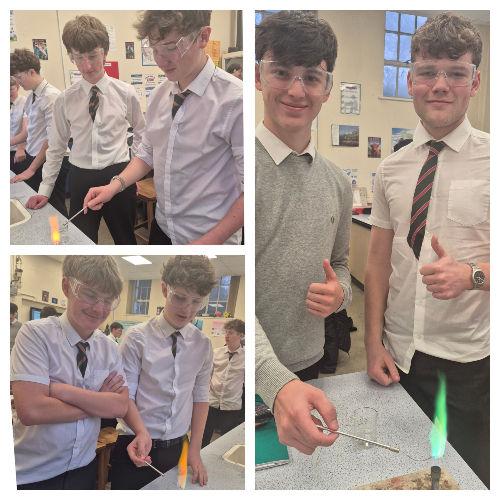
Mr Spencer, Teacher of Science, shared that our Year 11 group (11b8) tested different salt solutions to see the colour of the flame they create. From the colour, they are able to identify an unknown salt! Lovely to see bright reds, greens and yellows!


Mrs Pearson, Teacher of Chemistry shared that her Year 11 class have been enjoying conducting flame tests this week. They have had to identify cations based on the colour flame they produce when heated. Lots of fantastic collaboration and displays of excellent lab skills produced plentiful beautiful flames. The students were challenged to identify unknown solutions and did very well, as some colours are hard to distinguish: is it golden yellow; orange; or orange-red? These metal ions are what give fireworks their different colours, so it felt like a good practical to start the festive season!


Mr Winstone, Deputy Headteacher - Teaching & Learning, shared that Year 9 Chemists have been drawing dot cross diagrams for ionic compounds ahead of using practical tasks to confirm predictions around properties of these compounds. They have been working superbly so far this year, building up a really secure knowledge foundation and so they have taken this complicated topic in their stride.


Careers & PSHE
Mr Scott, Leader of Careers & PSHE, shared that a group of 23 Year 11 students recently took part in an interview preparation workshop led by Callum from the Babcock External Engagement Team. The session was designed to support students as they begin thinking seriously about their next steps and potential apprenticeship pathways.
During the workshop, students learned how to prepare effectively for interviews, including researching employers, understanding the role they are applying for, and presenting themselves confidently. Callum shared practical advice on answering common interview questions, communicating clearly, and making a positive first impression, helping to demystify the interview process.
The session comes at a perfect time, as students will be putting these skills into practice during their mock interviews later this month. These mock interviews will play an important role in preparing students for real apprenticeship applications, building confidence and giving them valuable experience of a formal interview setting. We would like to thank Callum and the Babcock team for supporting our students and helping them develop essential employability skills.

Geography
Miss Taylor, Teacher of Geography, shared that as part of concluding our Making Sense of the World topic in RS this term, Year 7 students were invited to reflect on a public figure they find inspirational, someone who has shaped the way they understand the world or influenced an area they are passionate about. While there were plenty of Cristiano Ronaldo, students also explored figures such as David Attenborough, Steve Backshall and Brian Johnson, sparking thoughtful discussion about influence, values and purpose.
Pictured is a snippet of the ‘bio-cubes’ students created, which brought together key facts, quotes and ideas from their chosen figures. This creative task encouraged students to consider how people make sense of the world in different ways, through sport, science, exploration, activism and innovation. It felt like a really positive and reflective way to end the topic, celebrating curiosity, individuality and the diverse role models that inspire our students.

Mrs Coles, Teacher of Geography, shared that throughout this academic year we have asked Key stage 3 students to read one Geography related book per term. We have asked students to engage in this to improve their range of geographical knowledge but also to widen their vocabulary and link to the wider school focus of oracy. We have been really impressed by the students' efforts, with many boys reading the three books in the first term.
Here are some of the reflections from students in 8S.
Title of book: Thin Air
Author: Michelle Paver
A short summary of the book: 5 English people in the British Raj go to climb the 3rd tallest mountain in the world, Kanchenjunga. The 5 names of them are Dr Pearce, Kits, Garrad, McLellan and Major Cottorel. They overcome a series of peaks until they finally get the actual mountain in the range, and they begin to climb. Mclellan broke his wrist after falling over so he couldn't climb the mountain. A dog called Cedric comes on the journey, but gets lost and dies in a snowstorm close to the summit. Later, the brother of the main character called Kits goes the wrong way and the ice breaks and he falls to his death. They return back and Dr Pearce is haunted, the same way the other climber called Charles Tennant was haunted 30 years before after most of his crew died.
What did you learn about Geography from reading this book? From this book, I learnt how beautiful mountain ranges can appear, but also how deadly they are as well. The most unexpected things can happen, and it could end everything before someone could even process it. It shows how people want to do things that they know are dangerous, just for the fun of it. Along with this, the description of the mountain as they get closer tells us that there is no ecosystem with any life up there. It is just a harsh, barren wasteland. People may climb for the fun of it or to achieve something, not realising how dangerous nature and mountains can actually be.
Title of book: How bad are bananas?
Author: Mike Berners- Lee
A short summary of the book: This book is about the carbon footprint of things we use/eat on a day to day basis. It shows us how little changes in our routine can sometimes help with the carbon emissions around the world, and how a choice we believe is good for the planet could actually be quite bad. An example of this is eating a banana. We may think it is quite good for the planet as it is natural and does not need making, however it could be bad because of the flight from where it is grown to where it is needed.
What did you learn about Geography from reading this book?: From this, I learnt how the world is suffering because we are eating/using products from around the world. This is not just about carbon emissions however, it uses the term carbon footprint to describe the carbon dioxide and all of the other greenhouse gases that are produced from these flights, or the production of certain things. It shows us how everyone has to unite to stop these greenhouse gases polluting our atmosphere.
Title of book: The Explorer
Author: Katherine Rundell
A short summary of the book: The book is about 4 children who are present in a plane accident over the Amazon and become stranded there. They learn to survive there and learn key skills to survive in this unique climate and biodiversity of animals. In the end, they travel to a forgotten Amazon city covered in trees and meet an explorer there. The explorer does not welcome them well at first, but agrees to give them a plane he has rebuilt from scrap parts to fly to Manaus to help one of the children bitten by poisonous ants. Then they live together happily ever after, swearing to keep the forgotten city a secret between them.
What did you learn about Geography from reading this book? I learnt that the Amazon Rainforest is actually a very diverse place to be and contained lots of interesting animals that I did not know existed or actually lived there. What surprised me is that there were also usual bees there as well that made honey too. I also found out that the jungle was a more hostile place than I thought it would be, and I learnt of other dangers that existed there. I also learnt about the city of Manaus in the rainforest, and this was new and I found out that there were more human settlements in the Amazon than I previously thought.
Title of book: Running Wild
Author: Michael Morpurgo
A short summary of the book: Running wild is about a child called Will who went to Indonesia to stay for a bit and a tsunami hits them, so he and his friend who is an elephant have to learn to survive in the jungle and stop poachers from hunting their fellow animals like orangutans, or stop them from cutting down the jungle.
What did you learn about Geography from reading this book? I learnt from this book that there are various reasons for global warming and natural disasters or extinction of animals in different areas and not just from natural causes. This book highlights the danger which animals and their habitats have to face like people hunting them directly for their fur, skin or other reasons like medicine, getting rid of their habitats/homes for things like wood or just hunting them for the sake of it. It shows that we can't always blame the world for its state and highlights the fact that we are also affecting it.
Food Preparation & Nutrition
Miss Franklin, Teacher of Food Preparation and Nutrition, shared photos of students in her two Year 9 classes decorating Christmas cakes that they made.


Entrepreneur Showcases 3D Printing Business at Christmas Fayre
Year 7 student Grayson put his entrepreneurial skills into action at his former primary school’s Christmas Fayre, held at King’s School on Friday 28th November. Returning as a young creator and business owner, Grayson set up and ran a stall selling a range of 3D-printed products, all of which he designed and produced himself.
What made Grayson’s stall particularly impressive was the level of preparation behind it. Drawing on what he has learned in Digital Enterprise at DHSB, he developed a full business plan, including a pricing strategy and profit calculations. Using Google Sheets, he created his own price list complete with formulas to work out costs, revenue, and profit margins - an excellent example of using digital tools for real-world applications.
Digital Enterprise at DHSB is a unique subject, combining 50% Business and 50% Computer Science across Years 7 and 8. In the business strand, students build entrepreneurial, financial, and IT skills to prepare them for the workplace. In the computer science strand, they learn coding and computational thinking, applying these to solve problems creatively and logically.
Grayson’s project brings both sides of the subject together brilliantly: creativity, product design, digital manufacturing, financial planning, and real-world selling. His initiative demonstrates what can be achieved when students combine technical skill with entrepreneurial spirit.
Well done, Grayson - an inspiring example of innovation, hard work, and enterprise in action.
Mr Scott
Head of Computer Science

Sparx Maths and Sparx Reader
Each week we celebrate our highest performers in both Sparx Maths and Sparx Reader, two of our core homework platforms. We are proud of all of our students who complete their homework each week to such a high standard but these students deserve a special mention!
Congratulations!


Every Christmas I look forward to going to the panto at the Theatre Royal - this year it was doubly exciting as, for the second year in a row, two of our alumni were involved. It was fantastic from start to finish - Samuel Holmes shone as ‘The Spirit of Bow Bells’ and Duncan Waugh is the talented Musical Director.
It was a pleasure to meet them both after the show - oh yes it was!. Tomorrow is the last day so you will have to be quick if you want to catch it.
Beverley Kinsella
Alumni Engagement & Archives


PTFA News
Happy New Year!
Our first meeting is on the 14th January, 6.30pm in the Conference Room (directly behind the Visitor Reception). Please join us if you can - we’d love to meet you.

Beverley Kinsella
PTFA Liaison